


You know what’s weird? I can spend twenty minutes standing in front of the fridge, staring at perfectly good ingredients, and still end up ordering takeout. Not because I’m lazy. Not because I don’t care. But because the entire process of deciding what to make, checking if I have everything, figuring out timing—it just feels like too much.
If you’ve ever felt completely drained by the simple question “what’s for dinner,” you already know why does healthy eating feel so hard. It’s not really about the food. It’s about everything your brain has to do before the food even gets on your plate.
There’s this heaviness that kicks in somewhere between “I should eat better” and actually doing it. Like you’re carrying something invisible but exhausting. And yeah, I’m tired of pretending that’s a personal failing when it’s actually… something else entirely.
What’s Actually Happening in Your Brain

Look, here’s the deal: every food decision you make burns through something called executive function. That’s basically your brain’s ability to plan, decide, and follow through on things. And you don’t have an unlimited supply.
By the time you’re thinking about dinner, you’ve already made dozens—maybe hundreds—of decisions that day. What to wear. Which emails to answer first. Whether to take that call. What route to drive. Every single one depletes the same mental resource you need for “let me chop vegetables and cook a balanced meal.”
This isn’t me guessing. Decision fatigue is a real thing, and it hits food choices especially hard because we have to make them multiple times per day, every single day, forever.
I’ve noticed something: the days I feel most defeated about eating well aren’t the days I’m busiest. They’re the days where I’ve had to make a bunch of complicated decisions about other stuff. Like dealing with insurance claims or figuring out childcare logistics or just… navigating normal life things that require mental effort. By 6 PM, my brain is just done.
What People Get Wrong About “Eating Better”

The frustrating part? Most healthy eating advice completely ignores this.
It’s all “just meal prep on Sunday” or “keep it simple” or “plan your week.” Which, fine—those aren’t bad ideas. But they assume you have the mental bandwidth to execute them. They assume the hard part is knowledge or time, when really, the hard part is the invisible cognitive work that happens before you even start.
I’ll be honest, I’ve tried the whole “prep everything on Sunday” thing multiple times. And sometimes it works great. But sometimes Sunday rolls around and I’ve already used up all my decision-making energy dealing with a surprise medical bill or a work crisis or just existing through a tough week. And then I’m supposed to plan five dinners, make a detailed shopping list, and execute a three-hour cooking marathon?
It’s like everyone’s giving advice for a version of life that doesn’t include regular human exhaustion.
Here’s the uncomfortable truth: the people who make healthy eating look effortless often have less mental load in other areas of their life. Maybe they have more support. Maybe they work from home. Maybe they don’t have to coordinate care for aging parents or manage a chronic condition. I’m not saying it to be bitter—just realistic.
The Real-Life Factors That Make This Worse
The mental exhaustion and food choices thing doesn’t exist in a vacuum.
You’re dealing with work stress, maybe financial pressure, possibly health issues that already require tracking and management. Every prescription refill you have to call about, every appointment you have to schedule, every form you have to fill out—that’s all pulling from the same mental tank you need for “let me make a healthy dinner.”
I remember sitting in a clinic waiting room once, already running late, knowing I hadn’t eaten anything decent all day. I’d planned to grab something healthy on the way home. But after an hour of waiting, then the appointment, then stopping at the pharmacy where they didn’t have my prescription ready yet… I just sat in my car and ate fast food in the parking lot. Not because it was what I wanted. Because it required zero additional decisions.
That moment—sitting in a parking lot, too tired to care—that’s the reality nobody puts in their meal planning Instagram posts.
The cognitive load of healthy eating multiplies when you’re already managing other stuff. If you have dietary restrictions for health reasons, now you’re reading every label. If you’re on a budget, you’re calculating cost per serving while shopping. If you have kids or a partner with different preferences, you’re negotiating and compromising before you even turn on the stove.
And God forbid you’re dealing with any level of anxiety or depression, because those absolutely wreck your executive function even more.
What Actually Helps (And What Probably Won’t)
I guess what I’m trying to say is: you need strategies that acknowledge you’re already tired.
Here’s what’s actually made a difference for me, with the full admission that it’s imperfect and some weeks it falls apart completely:
1. Decide once, repeat forever (or until you’re sick of it)
Pick 3-5 meals you can make without thinking. Not recipes you have to look up. Meals you’ve made so many times you could do them half-asleep. Rotate through those. Yeah, it’s boring. But decision fatigue from meal planning is real, and boring is sometimes the price of sustainable.
The trade-off: You’ll get tired of eating the same things. But that’s actually easier to manage than decision paralysis every single night.
2. Make “good enough” your actual goal
A rotisserie chicken from the grocery store and bagged salad is healthy eating. So is frozen vegetables microwaved with butter and whatever protein you have around. Canned soup with added frozen veggies counts too.
This might not work for you if you genuinely love cooking and find it relaxing—but if you’re reading this, you probably don’t right now. And that’s fine.
3. Shift decisions to when you have more energy
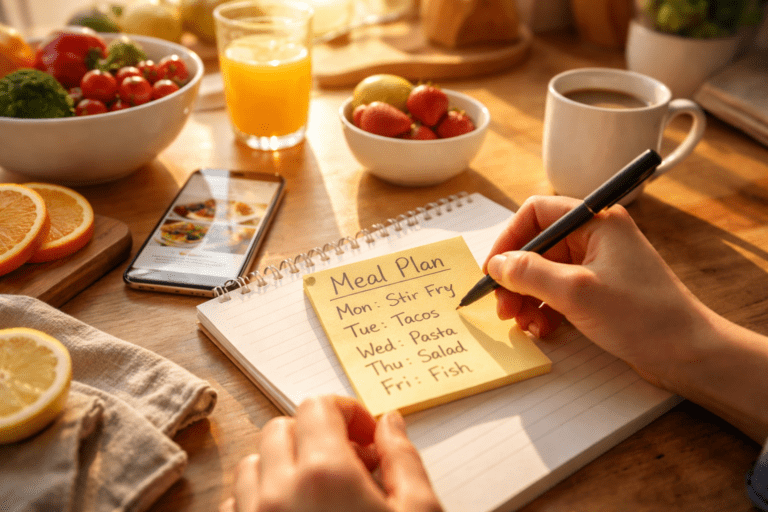
If mornings are your better time mentally, decide dinner in the morning. Write it on a sticky note. “Tonight: pasta with jarred sauce and frozen broccoli.” Sounds simple, but what actually happens is this: you get to 6 PM exhausted, see the note, and you don’t have to decide anything. You just follow instructions from past-you who had more brain capacity.
4. Automate the stuff you can afford to automate
This is where the money vs. energy trade-off comes in. Pre-cut vegetables cost more. Meal kit subscriptions cost more. Grocery delivery costs more. But if it means you actually eat something decent instead of skipping meals or defaulting to junk, it might be worth it.
I’m not saying everyone can afford this. I’m saying if you have any wiggle room in your budget, this is worth considering. Calculate what you spend on emergency takeout when you’re too fried to cook—it might be close.
5. Keep a “depleted day” backup plan
Have one meal option that requires basically zero cognitive effort. For me it’s scrambled eggs and toast. For you maybe it’s a specific frozen meal you actually like, or a peanut butter sandwich, or instant oatmeal with fruit. Something that still counts as eating but doesn’t require decisions or multiple steps.
6. Reduce the number of decisions per meal
One-pot meals. Sheet pan dinners. Things where you dump stuff together and walk away. The fewer steps and decisions involved, the less mental energy required.
7. Stack this with something you’d do anyway
Listen to a podcast you like while cooking. Put on music. Make it slightly less of a chore by pairing it with something your brain finds rewarding. Or maybe not exactly that—sometimes that backfires and adds more stimulation when you’re already overstimulated. You’ll have to test this one.
Look, none of this is revolutionary. And some weeks you’ll still end up eating cereal for dinner or ordering pizza three nights in a row. The point isn’t perfection—it’s reducing the mental friction just enough that healthy-ish eating becomes possible more often.
When This Might Be More Than Just Stress
Here’s something I should probably admit: there’s a difference between normal decision fatigue and something that needs actual professional help.
If too tired to cook healthy meals has turned into “I’m barely eating at all” or “I can’t make any decisions about anything,” that’s worth talking to a doctor about. Depression, anxiety, ADHD, thyroid issues, chronic fatigue—lots of health stuff shows up as executive dysfunction.
The tricky part is that getting help requires… more executive function. You have to find a provider, make an appointment, show up, explain what’s wrong. If you’re already depleted, that feels impossible.
If you can, ask someone to help you take that first step. A friend who can look up therapists. A partner who can make the call. There’s no shame in needing help to access help—the system isn’t designed for people who are already struggling.
Red flags worth mentioning: significant unintentional weight changes, inability to care for yourself beyond just food, feeling completely numb or hopeless, thoughts of self-harm. If any of those apply, it’s genuinely urgent even though I know finding care is exhausting and possibly expensive.
I put off talking to anyone about my own stuff for way too long because I kept thinking “I should be able to handle basic things like feeding myself.” Turns out that kind of thinking just makes it worse.
The Part Where I Don’t Have Perfect Answers
I’m not gonna end this with some uplifting message about how you can totally do this if you just believe in yourself or whatever.
The truth is why does healthy eating feel so hard isn’t a question with one simple answer. It’s hard because life is complicated and your brain has limits and the world demands a lot from you before you even get to thinking about dinner.
Some days you’ll have more capacity and it’ll feel manageable. Other days you’ll eat crackers standing at the counter and that’ll have to be enough. Both of those are just… part of being human with finite energy.
I guess I’m still figuring out where the line is between “give myself grace” and “develop systems that actually work.” Probably it’s different for everyone. Probably it changes based on what else is happening in your life.
What I do know: you’re not failing at something that should be easy. You’re managing something that’s actually hard, and most people just don’t talk about why. The mental load is real, and acknowledging it doesn’t fix it, but it at least stops you from feeling like you’re uniquely broken.
If even one of those strategies makes your week slightly less exhausting, that’s worth something.
Disclaimer: This article is for informational purposes only and reflects personal experience and general research. It is not medical advice. Always consult a qualified healthcare professional regarding your health concerns.
[…] Mental Load and Food Choices: Why Eating Well Feels Harder Than It Should […]
[…] […]
So, риквипарт, eh? I’ve been hearing a lot about this one, always pops up in my searches. Is it worth the hype? Anyone have any insider info or experiences to share? Check it out here: rikvipart
[…] ~Mental Load and Food Choices: Why Eating Well Feels Harder Than It Should […]
[…] ~Mental Load and Food Choices: Why Eating Well Feels Harder Than It Should […]
[…] ~Mental Load and Food Choices: Why Eating Well Feels Harder Than It Should […]
[…] ~Mental Load and Food Choices: Why Eating Well Feels Harder Than It Should […]
[…] ~Mental Load and Food Choices: Why Eating Well Feels Harder Than It Should […]
[…] ~Mental Load and Food Choices: Why Eating Well Feels Harder Than It Should […]