

Bird Flu in the US: Real Risk or Media Panic?
If you’ve been half-paying attention to the news lately, you’ve probably seen headlines about bird flu. Maybe you scrolled past them. Maybe you thought, “Oh great, another thing to worry about.” Or maybe you saw something about raw milk and rolled your eyes. After COVID, most of us have developed a kind of fatigue around disease warnings. The pattern feels familiar: alarming headline, conflicting expert opinions, unclear guidance, then the story fades until the next one.
So here’s the honest question a lot of people are asking themselves, even if they don’t say it out loud: Should I actually be paying attention to this, or is this another case of media hype outpacing reality?
The short answer is somewhere in the uncomfortable middle.
What’s Actually Happening
H5N1—the technical name for this strain of bird flu—has been around for decades. It’s been killing wild birds and domestic poultry worldwide since the late 1990s. What’s different now, and what’s caught the attention of public health officials, is that it’s spreading in ways it hasn’t before.
In early 2024, the virus was detected in US dairy cattle. That was unexpected. Influenza viruses infecting cows is unusual, and it raised a red flag because mammals are biologically closer to us than birds. The virus has now been confirmed in dairy herds across multiple states—at least a dozen, possibly more, because testing has been inconsistent and voluntary in many places.
A handful of farmworkers have been infected. Most cases have been mild—conjunctivitis, basically pink eye, sometimes with mild respiratory symptoms. One person was hospitalized. As of the most recent reports, no one in the US has died from this strain.
The virus has also been detected in raw milk. Pasteurized milk is safe—the heat kills the virus—but raw milk is a different story. Some samples have tested positive for viral RNA, and live virus has been recovered from unpasteurized products in lab settings.
The “It’s Overhyped” Argument
There’s a reasonable case for not panicking.
First, the virus is not spreading person-to-person. Every confirmed human case so far has involved direct contact with infected animals—usually cows or poultry. That’s an important distinction. Pandemic influenza happens when a virus learns to spread easily between humans through respiratory droplets, like the regular seasonal flu does. H5N1 hasn’t done that.
Second, the cases we’ve seen have been mild. The historic fear around H5N1 was based on data from earlier outbreaks in Asia, where the fatality rate in humans was horrifyingly high—over 50% in some clusters. But the strain circulating now, particularly in US cattle, seems to behave differently in humans. It might be less virulent. Or it might just be infecting healthier, younger farmworkers who recover quickly. We’re not entirely sure.
Third, we’ve been here before. For over 20 years, experts have warned that H5N1 could mutate into a pandemic strain. It hasn’t happened yet. That doesn’t mean it won’t, but it’s worth noting that influenza viruses don’t always evolve in the worst-case direction.
So if someone tells you bird flu is just another example of media fearmongering, they’re not completely wrong.
The “Take It Seriously” Argument
Here’s the uncomfortable part.
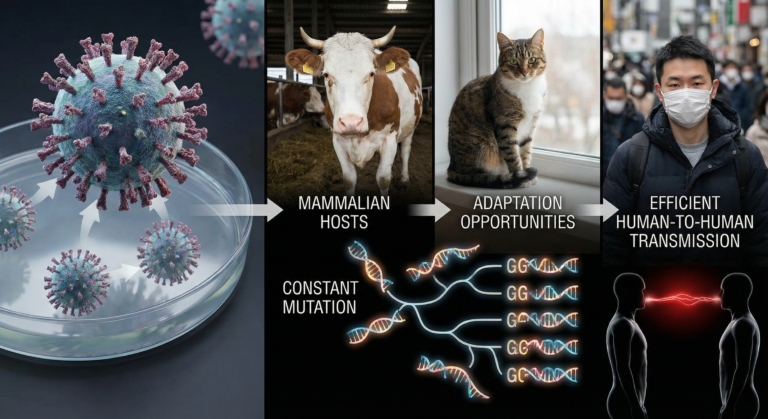
Every time this virus infects a mammal—a cow, a cat, a person—it gets another chance to adapt. Influenza viruses mutate constantly. Most mutations go nowhere. But the more the virus replicates in mammalian hosts, the more opportunities it has to stumble onto a combination of genetic changes that would allow efficient human-to-human transmission.
We don’t know how likely that is. No one does. Virologists can identify concerning mutations, and some have already been found in samples from infected cows and people. But predicting when or if a pandemic strain will emerge is beyond current science. We’re watching for warning signs, not reading a timetable.
The thing that should genuinely concern you isn’t the current situation—it’s the trajectory. The virus is expanding its host range. It’s in poultry, wild birds, dairy cattle, some cats that drank raw milk from infected cows, seals in other parts of the world. That’s a lot of mammalian hosts. That’s a lot of evolutionary runway.
And here’s an uncomfortable truth: our surveillance system has gaps. Testing in dairy herds has been slow to ramp up. Not all states have the same reporting requirements. Farm operators have economic reasons to avoid testing—a positive result can mean culling animals, lost income, quarantine. The number of infected herds we know about is almost certainly an undercount.
If the virus were spreading silently among people, would we catch it fast enough? Probably—eventually. But the early-warning infrastructure isn’t as robust as most people assume.
What About the Vaccines?
The US has stockpiled some H5N1 vaccine. Enough for maybe 10 to 20 million people, depending on dosing. That’s not nearly enough for the whole country, but it could cover healthcare workers, farmworkers, and high-risk groups in an emergency.
The complication is that flu vaccines are mostly made in eggs. Chicken eggs. If H5N1 tears through the poultry industry—which it’s already doing in some regions—that egg supply could be disrupted at exactly the moment we need to mass-produce vaccines. There are newer manufacturing methods (cell-based, mRNA), but scaling them takes time.
We also have antiviral drugs like Tamiflu that work against influenza, including H5N1. They’re not miracle cures, but they can reduce severity if taken early. The strategic national stockpile includes them. Whether that supply chain would hold up during a true pandemic is another question.
The Raw Milk Question
I know this is a politically charged topic for some people. Raw milk has passionate advocates who believe pasteurization destroys nutrients and beneficial bacteria. Some of that is true—pasteurization does change the milk’s microbial profile. Whether that matters for health outcomes is less clear.
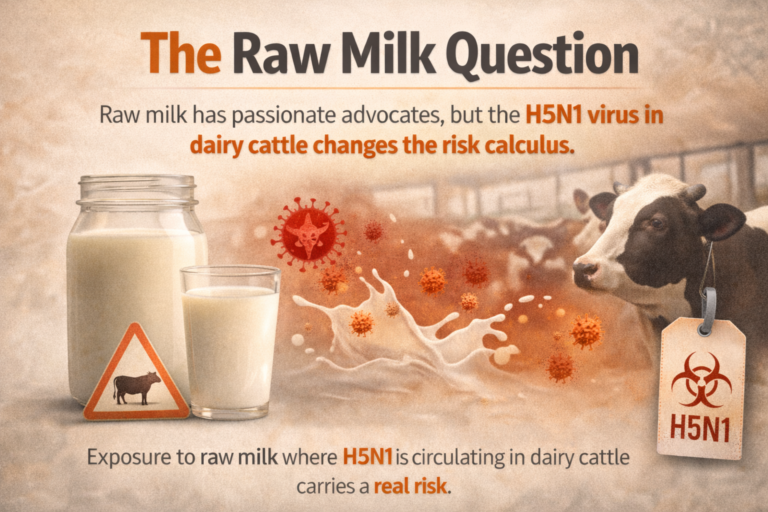
But here’s the practical reality: if you’re drinking raw milk from a region where H5N1 is circulating in dairy cattle, you are taking a real, non-theoretical risk. The virus has been found in milk. It can survive in refrigerated raw milk for days. We don’t yet fully understand what infectious dose might cause illness in humans, but exposure is exposure.
You can believe that raw milk has benefits and also acknowledge that right now, in this specific situation, the risk calculus has changed. That’s not government overreach. That’s basic food safety in the middle of an outbreak.
So What Do You Actually Do?
Here’s where I land on this, after reading the research, the CDC updates, the skeptic takes, and the alarmist warnings.
Don’t panic, but don’t tune out. This isn’t an emergency right now, but it’s worth tracking loosely. Subscribe to a reliable health news source or check the CDC updates once a month. You don’t need to follow every headline.
Avoid raw milk and raw dairy products for the time being, especially if you’re in a state with confirmed cattle infections. If you’re committed to raw milk, know your source and ask if they’re testing. Most aren’t.
Cook poultry and eggs thoroughly. This has always been good advice. Properly cooked, there’s no risk.
If you work with animals—poultry, cattle, or wild birds—take precautions. Wear gloves, wash your hands aggressively, and report any flu-like symptoms or eye infections to a healthcare provider. Mention the animal exposure. Doctors aren’t always thinking about bird flu unless you prompt them.
Keep your general health in order. This isn’t special bird flu advice; it’s just reality. Your immune system does better when you’re sleeping enough, not chronically stressed, eating reasonably, and staying active. That’s the baseline for handling any infectious disease.
Don’t assume the government will get everything right, but don’t assume they’re lying either. Public health agencies are imperfect. They’re slow, bureaucratic, sometimes politically influenced. They also employ people who genuinely know what they’re talking about. The truth is usually somewhere in the middle.
What we have right now is a slow-moving situation that could become serious or could fizzle out like dozens of previous scares. I don’t know which way it’ll go. Neither does anyone else. The best any of us can do is make reasonable choices with the information we have, stay flexible, and avoid both complacency and paranoia.
That’s the honest answer. It’s unsatisfying. But it’s realistic.
[…] […]