

Too Young to Feel This Tired: What's Really Behind Your Exhaustion
You know that moment around 2:30 in the afternoon when the screen starts to blur and you’ve read the same email three times without absorbing a word? When your coffee’s gone cold and you can’t remember if it’s your second cup or third, but it doesn’t matter because none of them are working anymore.

That’s the moment I want to talk about.
Somewhere in your 30s — or maybe your late 20s — a switch flipped. Not dramatically. Not overnight. Just this slow, grinding realization that you’re always tired in your 30s, even when you technically got “enough” sleep. The kind of tired that makes you feel decades older than your driver’s license says you are.
And here’s the frustrating part: everyone around you seems to feel it too, which makes it easy to dismiss. “Everyone’s tired,” we tell ourselves. “This is just being an adult.”
But is it? Should it be?
What Chronic Fatigue Actually Means
Before we go further, let’s get clear on terms. Because “tired” means different things to different people.
Chronic fatigue refers to persistent, unexplained exhaustion lasting more than six weeks that isn’t relieved by rest. It’s different from normal tiredness after a bad night’s sleep or a demanding week. It’s the kind that sits in your bones, that makes simple tasks feel monumental, that doesn’t lift even after a long weekend.
The key distinction: temporary tiredness has an obvious cause and goes away. Chronic fatigue lingers without clear explanation.
What’s Actually Happening in Your Body
Let me back up and explain what might be going on, because “you’re just tired” isn’t a diagnosis.
Persistent fatigue in your 30s and 40s can stem from dozens of overlapping factors. The obvious ones: poor sleep quality (not quantity — there’s a difference), nutritional deficiencies, unprocessed stress, dehydration, lack of movement, or too much movement without recovery.
The less obvious ones: thyroid dysfunction, iron deficiency or anemia, blood sugar instability, chronic low-grade infections, hormonal shifts, sleep apnea you don’t know you have, or depression wearing the mask of physical exhaustion.
What I’ve noticed, over years of talking to friends, coworkers, and reading way too many health forums at midnight, is that most people experiencing unexplained fatigue have some combination of three or four factors happening simultaneously. It’s rarely one clean answer. There’s usually disrupted sleep plus poor nutrition plus chronic stress plus something physiological that could be caught with bloodwork — all stacked together like a Jenga tower of exhaustion.
That’s what makes this so hard to fix. You can’t just pull one block.
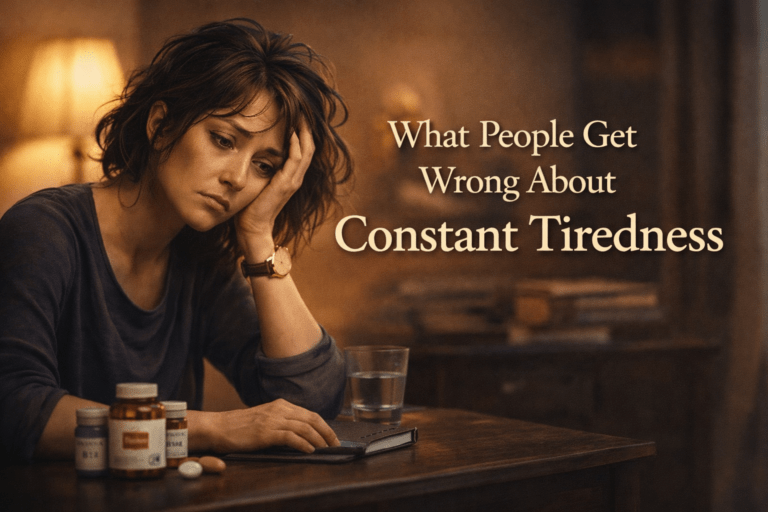
What People Get Wrong About Constant Tiredness
Here’s where I get a little frustrated, honestly.
The wellness industry loves simple answers. Sleep more! Drink water! Take this supplement! Optimize your morning routine with a 5am cold plunge! And look, none of that is entirely wrong. It’s just… incomplete.
What nobody tells you — and this still bugs me — is that you can do everything “right” and still feel exhausted if there’s an underlying issue nobody’s bothered to look for. I’ve watched people drink their 64 ounces, take their B12, go to bed by 10pm, and still drag themselves through every single day wondering what’s wrong with them.
Nothing’s wrong with them. Something’s wrong with the approach.
The other misconception that drives me a little nuts: the idea that constant tiredness is just what happens when you’re an adult with responsibilities. Like fatigue is the price of admission for having a job and kids and a mortgage. That’s a story we tell ourselves to avoid looking deeper, because looking deeper is scary and expensive and time-consuming.
But here’s the thing. Feeling moderately tired sometimes? Normal. Feeling bone-deep exhausted constantly, despite adequate rest? That’s a signal. Your body isn’t failing at adulting. It’s trying to tell you something.
The Uniquely American Side of This Problem
Now let’s talk about what makes this harder in the United States specifically, because context matters.
Our healthcare system is… complicated. You might recognize you need help but put off making an appointment because you’re not sure if this counts as something your insurance covers, or whether you need a PCP referral first, or if fatigue is “serious enough” to justify the $50 specialist copay. The specific dread of opening an Explanation of Benefits letter after getting some bloodwork done — only to discover you’re on the hook for $400 because one test was coded as “screening” instead of “diagnostic” — keeps a lot of people from even trying.
Then there’s American work culture. Most of us don’t have the kind of PTO that allows for actual rest. Taking a sick day when you’re “just tired” feels irresponsible. So you push through, which makes the fatigue worse, which makes you less productive, which stresses you out more. It’s a perfect loop.
And our climate doesn’t help either. If you live anywhere north of Tennessee, you’re dealing with vitamin D deficiency for at least four months of the year. That’s not a small thing. According to the NIH, vitamin D affects energy, mood, and immune function — and millions of Americans are walking around depleted without knowing it.
We’ve built a lifestyle where exhaustion is practically structural.
What Actually Helps: Realistic Steps That Account for Real Life
Okay. Here’s where I’m supposed to give you a neat list of solutions. I realize this sounds like standard advice — but stick with me, because I’m going to be honest about what actually happens with each one.
Get baseline bloodwork done.
This is the starting point. Request a complete metabolic panel, CBC, thyroid panel (TSH, free T3, free T4), iron studies including ferritin, and vitamin D levels. Your PCP should be able to order these, though you might have to specifically ask. ” ‘I’m experiencing persistent fatigue and want to rule out basic causes’ is your script.”
Reality check: you’ll wait 2-3 weeks for an appointment, another week for results, and possibly another appointment to discuss them. Budget $30-150 depending on your plan. Worth it.
Track your sleep honestly.
Not your sleep app’s score — your actual experience. Are you waking up in the middle of the night? Snoring? Waking up feeling like you never slept at all? These patterns matter more than hitting some number.
Here’s what actually happens, though. Your doctor says “get better sleep.” You nod, walk out, and immediately check your phone because there’s a work Slack that can’t wait. And nothing changes.
I know. I’ve done this too.
Look at what you’re eating—and when.
I’m not going to tell you to overhaul your diet. But blood sugar crashes are real, and that afternoon slump might be directly connected to what you had for lunch. The sad desk salad that left you hungry by 2pm. The carb-heavy Sweetgreen bowl that knocked you out by 3pm.
Notice patterns before you change anything.
Move, but don’t overdo it.
There’s a strange paradox where both too little movement AND too much intense exercise can contribute to chronic fatigue. A 20-minute walk often does more for sustained energy than a 60-minute HIIT class when you’re already depleted.
Audit your stress honestly.
This is the one most people—myself included—skip. We know we’re stressed. We don’t want to look at it directly. But chronic stress keeps your cortisol elevated, which disrupts sleep, tanks energy, and creates systemic inflammation.
You don’t need to fix it immediately. Just… acknowledge it’s there.
- Check what you’re drinking.
Caffeine after noon can disrupt sleep architecture even if you fall asleep fine. Alcohol, even one glass of wine, fragments your sleep quality more than people realize. Neither of these is about judgment. It’s just data.
- Review your medications.
Several common medications list fatigue as a side effect—some antihistamines, blood pressure meds, SSRIs, and even hormonal birth control. Worth a conversation with your doctor or pharmacist at CVS.
When You Actually Need to See a Doctor

Here are the signals that warrant pushing past the insurance headaches and actually making an appointment:
Fatigue that doesn’t improve after 2-3 weeks of consistent, quality sleep
Fatigue accompanied by unexplained weight changes (up or down)
Fatigue with brain fog, hair loss, or constantly feeling cold (thyroid red flags)
Fatigue with shortness of breath, dizziness, or rapid heartbeat
Fatigue that makes normal daily activities feel genuinely impossible
I’ll be honest — I ignored my own exhaustion for years. Wrote it off as stress, as being busy, as just how life is when you’re approaching 40 with a job and kids and all the rest. When I finally got bloodwork done, my vitamin D was basically non-existent and my thyroid was borderline sluggish. Not dramatic enough for medication, but enough to explain a lot.
Getting that information didn’t fix everything overnight. But it gave me something concrete to work with instead of just feeling vaguely broken.
What I Actually Want You to Take From This
I know I’ve just written a lot of words that essentially boil down to “it’s complicated, get bloodwork, pay attention to yourself.” That might feel unsatisfying. I get it.
But here’s what I actually want you to take away: feeling always tired in your 30s isn’t something you should just accept as the new normal. It’s not a character flaw or a failure to adult correctly. And you’re not being dramatic by wanting to feel better.
Sometimes the fix is something concrete and medical. Sometimes it’s slower and involves uncomfortable life changes. Often it’s both.
What I’m less willing to accept — for myself or for you — is the idea that we’re all just supposed to feel this tired forever, and that’s fine.
It’s not fine.
And feeling too young to feel this tired? That’s not whining. That’s information worth paying attention to.
[…] […]