


That familiar heaviness after lunch — and what your food choices might actually have to do with it
It usually starts around half two. Maybe quarter to three. You’ve had your lunch, you’ve made another tea, and now something’s shifting. Not tiredness exactly — more like your brain’s been packed in cotton wool. The screen in front of you blurs slightly, just at the edges, and you find yourself reading the same sentence for the third time without any of it landing. Your eyelids aren’t closing, but they want to. God, they want to.
You’re not ill. You slept reasonably well. You haven’t run a marathon. And yet your body is behaving as though someone’s quietly turned your dimmer switch down.
If this sounds familiar, you’re far from alone. That afternoon energy crash — that thick, sluggish feeling that descends most weekdays like clockwork — is something millions of us just accept. We blame the weather. We blame Monday. We blame getting older. But for a lot of people, the real cause is sitting right there on the plate they cleared an hour ago.
Not always. But more often than most of us realise.
What’s Actually Happening When Your Energy Crashes After Lunch
What’s Actually Happening When Your Energy Crashes After Lunch
Here’s the basic mechanism, stripped of the jargon.
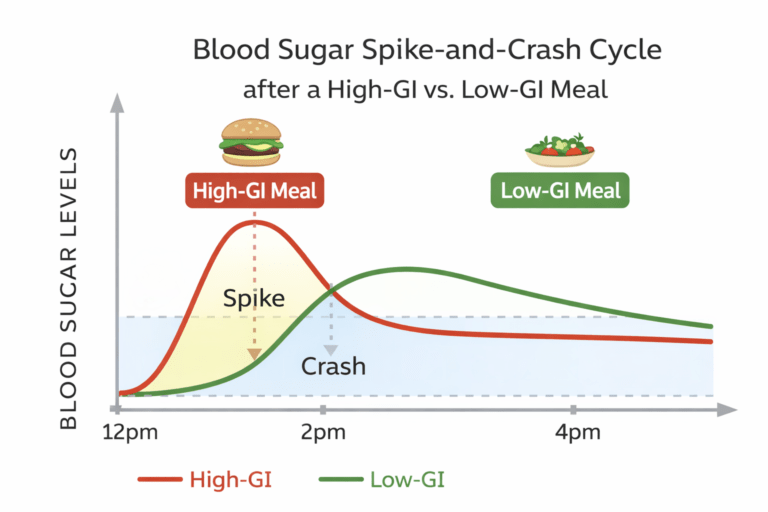
When you eat — particularly foods heavy in refined carbohydrates or sugar — your blood sugar spikes. Your body responds by releasing insulin to bring it back down. The problem is, insulin can overshoot. So your blood sugar doesn’t just return to normal — it drops below where it started. That dip is what you feel. The fog. The heaviness. The vague sense that your body has entered some kind of power-saving mode.
This is sometimes called a post-lunch slump, though it’s not really about lunch itself. It’s about what you ate for lunch. And breakfast, actually. And whether you’ve been running on caffeine and a cereal bar since seven in the morning.
What I’ve noticed, again and again — in colleagues, friends, family — is that the people who crash hardest in the afternoon tend to be the ones who either skip breakfast entirely or eat something that sounds healthy but is essentially sugar in disguise. Granola. Fruit juice. Those yoghurts with the “no added sugar” label that still contain 18 grams of the stuff per pot.
Your body doesn’t distinguish between a spoonful of table sugar and the sugar in a supposedly wholesome flapjack. It processes both, spikes, crashes. And you’re left wondering why you can’t focus on anything more complex than staring out the window.
The glycaemic index — how quickly a food raises your blood sugar — matters here. Foods with a high GI hit your bloodstream fast and leave fast. Low-GI foods release energy more gradually. It’s not a perfect system, and I wouldn’t suggest building your entire diet around it. But understanding the basic principle helps explain why a white bread sandwich and a packet of crisps leaves you comatose by three, while the same amount of food built differently doesn’t.
What Most People Get Wrong About Low Energy in the Afternoon
There’s a common assumption that an afternoon energy crash is just… normal. A biological inevitability. “Everyone gets tired after lunch,” people say, as though it’s written into human firmware.
And to be fair, there is a natural dip in your circadian rhythm in the early afternoon. That part’s real. But — and this is important — there’s a significant difference between a mild, barely noticeable lull and that wall-of-fatigue feeling where you genuinely consider putting your head on the desk.
What nobody tells you — and this still irritates me — is how much of the “healthy eating” advice out there is actually setting people up for exactly this problem. Low-fat diets, for instance. When you strip fat out of food, manufacturers tend to replace it with sugar or refined starch to keep it palatable. So you eat your “healthy” low-fat lunch, feel virtuous, and then hit the floor at 2:45pm.
Or the idea that fruit is always a good snack. It can be. But a banana and a glass of orange juice on an empty stomach is a significant sugar load. Paired with some protein or fat? Different story. On its own? You might as well have had a biscuit. Or rather, the blood sugar response isn’t vastly different. Which feels almost unfair.
The other thing people get wrong is blaming willpower. “I just need to push through it.” You don’t need to push through it. Your body is having a physiological response to what you fed it. That’s not weakness. That’s chemistry.
Why This Hits Differently If You Live in the UK

I don’t think we talk enough about the specifically British factors that make afternoon energy crashes worse.
Start with the weather. From roughly October to March, most of us are operating in some degree of grey, low-light gloom. Your body produces more melatonin when light is limited. So you’ve already got a biological headwind before food even enters the picture. Add a blood sugar crash on top of that and it’s honestly remarkable anyone gets anything done between January and March.
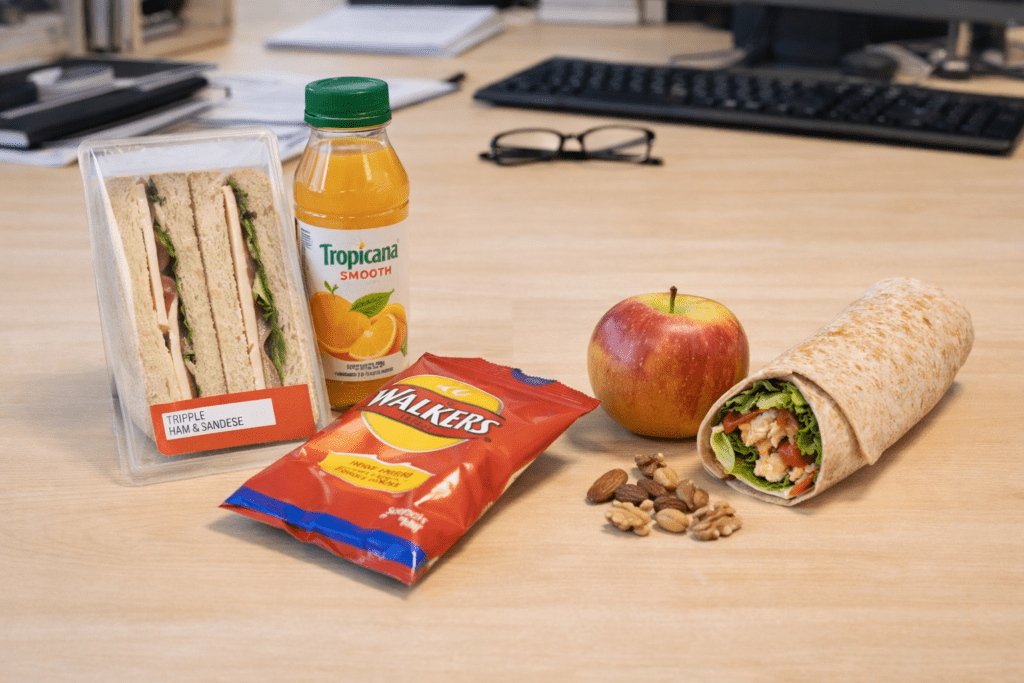
Then there’s work culture. The UK has some of the longest working hours in Europe, and the lunch break has been slowly disappearing for years. Plenty of people eat at their desks — a meal deal from Tesco or Boots, usually — in about twelve minutes, then crack on. A supermarket meal deal is engineered for convenience and shelf life, not blood sugar stability. The sandwich is white bread. The drink is often sugary. The snack is a chocolate bar or crisps. It’s cheap, it’s fast, and it’s practically designed to produce a crash.
And then there’s that particular British reluctance to “make a fuss” about how you’re feeling. You wouldn’t ring your GP about being tired in the afternoon. You’d feel silly. You’d assume they had proper ill people to see. So you just carry on, mainlining tea, telling yourself it’s normal.
For most people, it probably doesn’t need a GP visit. But the fact that we collectively just absorb this level of daily fatigue without questioning it — that says something about how we’ve normalised feeling rubbish.
What You Can Actually Do About Your Afternoon Energy Crash
Right. Practical stuff. And I want to be realistic here, because I know what happens with lists like this.
In theory, you’d meal-prep balanced lunches every Sunday, meditate after eating, and take a brisk twenty-minute walk before returning to your desk feeling refreshed. In practice, you’ve got thirty minutes for lunch, the office kitchen smells faintly of someone’s leftover curry, and you’re eating a Pret baguette while answering emails. So let’s work with reality.
- Look at what you’re actually eating for breakfast.
If it’s cereal, toast with jam, or nothing at all — that’s your first problem. Try adding protein. Eggs. Greek yoghurt (the proper stuff, not the flavoured kind). Even peanut butter on wholemeal toast. Protein and fat slow the release of sugar into your blood. You’re not aiming for perfection. You’re aiming for “slightly less of a sugar rollercoaster.” - Rethink the lunchtime carb load.
You don’t need to go low-carb. But swapping white bread for wholemeal, or having fewer crisps and more of something with fibre, makes a genuine difference to how you feel two hours later. Adding some protein — chicken, cheese, hummus, beans — helps stabilise things. - Watch the drinks.
A large latte with syrup, a can of Coke, a fruit smoothie — these are all significant sugar hits that people don’t always count. Water is boring but effective. If you need caffeine, black coffee or tea without sugar is a better bet. - Eat lunch. Actually eat it.
Skipping lunch and then wondering why you’re shattered by three is like wondering why your car stopped when you didn’t put petrol in it. Your body needs fuel. Consistent, decent fuel. - If you can, move after eating.
Even ten minutes of walking helps. It genuinely does. Something about light movement after a meal helps your body manage blood sugar more effectively. You don’t need a gym. A walk round the block, or even just standing and stretching, is enough to blunt the worst of it. - Consider the timing.
Eating a massive lunch at 1pm after not eating since 7am is a setup for a crash. A small mid-morning snack — nuts, an apple with some cheese, that sort of thing — can take the edge off so you don’t demolish a footlong baguette at lunch out of sheer desperation. - Be honest about sugar.
I suppose what I’m trying to say is that most of us eat more sugar than we think. It’s in sauces, bread, “health” bars, ready meals, everything. You don’t need to eliminate it. But becoming aware of it — actually reading a few labels — can be quietly eye-opening. Sometimes disturbing.
None of this is revolutionary. I’m aware of that. But doing even two or three of these consistently tends to make the difference between a manageable afternoon dip and that full-body shutdown feeling.
When to Actually See Your GP
Here’s where I need to be straightforward.
An afternoon energy crash caused by diet is common and usually fixable. But persistent, unexplained fatigue — the kind that doesn’t improve regardless of what you eat — can sometimes signal something that needs proper investigation.
I’ll be honest — I ignored this for years. Assumed my tiredness was just stress, or poor sleep, or being in my late thirties. It took an almost embarrassingly long time before I mentioned it to my GP, and when I did, it turned out my iron levels were on the floor. A simple blood test. That’s all it took. I’d just been too stubborn — or too British — to ask.
The NHS recommends seeing your GP if fatigue has lasted more than four weeks without clear explanation. Other things worth flagging:
- Tiredness that doesn’t improve with better sleep or diet changes
- Unexplained weight changes
- Feeling excessively thirsty or needing to urinate frequently (which can indicate blood sugar issues worth investigating)
- Low mood or difficulty concentrating that affects your daily life
Your GP can run blood tests checking for things like thyroid function, diabetes, vitamin deficiencies, and anaemia. These are all common, treatable, and easy to miss if you’re just blaming everything on a bad night’s sleep.
NHS 111 is also there if you’re unsure whether something warrants a GP appointment. Use it. That’s literally what it’s for.
Where This Leaves You
I realise much of this sounds like standard advice dressed up in slightly more honest packaging. And maybe it is. But I think there’s value in saying plainly what most health articles dance around: you probably already know roughly what’s causing your afternoon energy crash. You just haven’t wanted to deal with it yet. Most of us — myself included — would rather have another coffee than actually change what we eat.
And that’s fine. For a while. But if you’re reading this at quarter past three with heavy eyelids and a vague sense of dread about the remaining hours of your workday, then something probably needs to shift. Not everything. Not overnight. Just something small and sustainable.
I don’t know if changing your lunch will transform your life. I doubt it. But it might transform your afternoon. And honestly? Some days that’s enough.
The afternoon energy crash isn’t something you just have to live with. It’s usually your body telling you — in its blunt, unsophisticated way — that what you’re feeding it isn’t working. Worth listening to, I’d say. Even if the answer is slightly annoying.