
Discover the truth about ultra-processed foods and food addiction. Learn how modern foods are engineered for cravings—and what you can do to regain control.
Let me start with a number that changes how you see food.
Nearly three-quarters of what fills a typical grocery store is ultra-processed.
That frozen pizza? Ultra-processed.
Those “healthy” protein bars? Very likely ultra-processed.
That colorful cereal marketed to kids? You already know.
Now here’s where it gets uncomfortable.
Researchers are beginning to compare these foods to addictive substances.
Sounds dramatic, right?
But when diet-related diseases cost over a trillion dollars every year, it’s worth asking an honest question:
Is this really just about willpower—or is something deeper going on?
Let’s clear up a common misunderstanding.
Processing Level | Examples | Verdict |
Unprocessed | Fresh fruits, vegetables | ✅ Eat freely |
Minimally processed | Frozen veggies, canned beans | ✅ Totally fine |
Processed | Bread, cheese | ⚠️ Moderate |
Ultra-processed | Chips, soda, fast food | ❌ Problem |
Ultra-processed foods are different.
They’re made using ingredients you wouldn’t find in a home kitchen, such as:
These foods aren’t just preserved or cooked.
This is where the debate heats up.
Researchers developed something called the Yale Food Addiction Scale, designed to measure addictive-like eating behaviors.
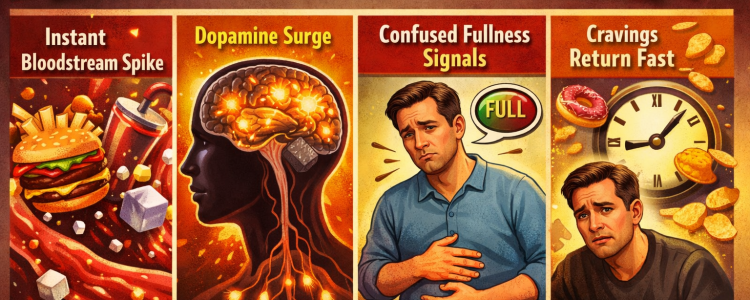
Foods that combine fat, sugar, and salt in precise ratios trigger powerful dopamine responses.
Finding | What It Means |
~20% of adults meet food addiction criteria | 1 in 5 struggle |
Ultra-processed foods linked to 30+ health conditions | Far beyond weight gain |
Majority of daily calories come from ultra-processed foods | This isn’t occasional |
Whether we label it “addiction” or not, one thing is clear:
Ever opened a bag of snacks intending to eat a little—then realized it was gone?
That’s not a lack of discipline.
That’s design.
Food companies invest heavily to discover the exact balance of sugar, fat, and salt that maximizes pleasure without causing boredom.
This is known as the bliss point.
Former regulators and researchers have openly described how products are engineered to:
Let’s simplify what’s happening biologically.
Eat → pleasure spike → crash → craving → repeat
Over time, your brain adapts.
You need more to feel the same effect.
That pattern is called tolerance—a core feature of addictive behavior.
This topic deserves balance.
The term “food addiction” may not be perfect.
But dismissing the problem entirely doesn’t help either.
A more accurate phrase might be:
engineered overconsumption.
And millions of people are living inside it.
This isn’t about perfection or restriction.
It’s about awareness and small, realistic shifts.
Red flags include:
If it looks like a chemistry exam, put it back.
Aim for whole foods most of the time.
Enjoy flexibility the rest.
Sustainability beats extremes.
You don’t need complex recipes.
Simple meals work.
Most ultra-processed foods sit in center aisles.
Fresh foods usually don’t.
Willpower fades. Environment doesn’t.
If trigger foods aren’t nearby, late-night decisions get easier.
Thirst often masquerades as cravings.
Drink water. Wait a few minutes. Reassess.
Struggling doesn’t mean you’re weak.
Packaged snacks, sodas, fast food, instant noodles, sugary cereals, frozen meals, processed meats.
Many people notice improvement within 2–4 weeks.
Replace sugary drinks with water or unsweetened options.
When health problems become widespread, individual discipline alone can’t explain it.
Systems matter. Design matters. Environment matters.
Ultra-processed foods are built to encourage overeating—but understanding that gives you power.
This isn’t about blame.
It’s about clarity.
Have you ever felt certain foods were harder to stop eating than others?
Share your experience. Someone reading might realize they’re not alone.