


Not tiredness exactly — more like your focus just… unhooks. You’re reading an email you’ve already read twice. The words are there. They’re English. But your brain has quietly decided it’s done processing language for the day. Somewhere around 2:30, maybe closer to 3, the fluorescent lights above your desk start feeling heavier. Like they’re pressing down on you. Your coffee from this morning is sitting there, cold, with that weird film on top. You should get up. You don’t.
The afternoon slump doesn’t announce itself. It seeps in.
And here’s the thing I keep coming back to—it’s not just you. I spent years thinking I had some personal defect. That I was eating wrong or sleeping wrong or just wired differently than people who seem fine at 3PM. Turns out those people aren’t fine either. They’re just better at faking it.
I want to talk about why this happens, what most advice gets wrong, and what’s actually helped me. Some of it might help you. Some won’t. I’m genuinely not sure — and I think that’s a more honest starting point than most health articles give you.
Why Your Body Shuts Down After Lunch Every Single Day
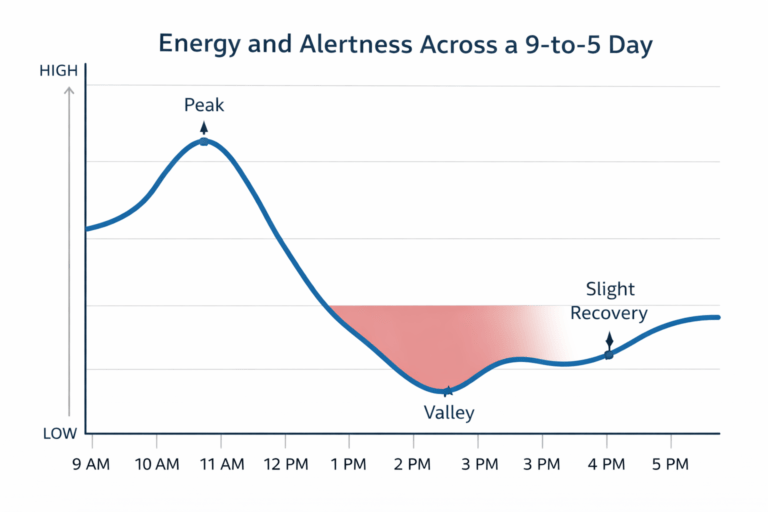
There’s real biology behind the 3PM crash, and it’s weirdly comforting once you understand it.
Your body runs on something called a circadian rhythm — basically a 24-hour internal clock that controls when you feel alert and when you feel like crawling under your desk. That clock has a built-in dip. Every day. Usually between about 1PM and 3:30PM. It’s not optional. You can’t skip it. You can only make it worse or slightly less awful.
Here’s what’s happening under the hood during that window. Cortisol — the hormone that had you feeling sharp and competent at 9AM — starts dropping. Not crashing, just… easing off. Meanwhile, melatonin (yeah, the sleep hormone) nudges up slightly. Not enough to knock you out. Just enough to take your edge off.
Your core body temperature dips a little too. That sounds minor but it’s the same signal your body uses at night to tell you it’s time for sleep. So your brain is getting mixed messages — the clock on the wall says 2:45PM, but your internal thermostat is whispering bedtime.
Then there’s blood sugar. If lunch was a sandwich and chips from the place downstairs, or honestly anything from the Panera drive-through, your glucose spiked hard around 12:30 and is now in freefall. That crash hits your prefrontal cortex first. Decision-making. Focus. The exact stuff your job requires all afternoon.
What I’ve noticed over probably ten years of office work — the people who get destroyed by this the worst are the ones who haven’t moved since they sat down at 8:30. Four-plus hours in the same chair, same angle, same screen, same recycled air. The body interprets prolonged stillness as a sleep cue. It’s doing what it’s supposed to do. The problem is you’re supposed to be awake for another three hours.
What Most Afternoon Slump Advice Gets Completely Wrong
This is the part that still gets under my skin.
Every wellness blog, every corporate health newsletter, every poster in the break room next to the microwave — they all say the same things. Drink water. Eat a balanced lunch. Get more sleep. Take breaks.
Fine. Sure. All technically true.
But what nobody talks about — and this genuinely frustrates me every time I think about it — is the gap between that advice and real life. Your company’s wellness program suggests a “mindful walk after lunch.” Meanwhile you’ve got a 1PM standup, a 1:30 client call, and your manager wants that deck revised before 3. When exactly is this walk happening?
The other thing that bothers me. There’s this underlying assumption that afternoon brain fog is a discipline problem. Like if you just tried harder, ate cleaner, slept better, you’d power through. That’s not how circadian biology works. You’re fighting neurochemistry. Willpower is useful for a lot of things. Overriding your internal clock every single day isn’t one of them. Or — okay, it is, technically. But not sustainably. And not without a cost.
And then there’s the caffeine trap. Reaching for coffee at 3PM feels like solving the problem. The NIH has data showing caffeine consumed six hours before bed still measurably disrupts sleep quality. So your afternoon espresso is quietly making tomorrow’s afternoon worse. It’s a loop. A really common one. And most people don’t connect the dots because the effects are delayed by twelve hours.
I realize I’m starting to sound cynical. I’m not. I’m just tired of advice that ignores context. Which, ironically, is exactly the kind of fatigue we’re talking about.
How Desk Job Culture Makes the 3PM Energy Crash Worse
I want to be careful here because I’m not trying to write a manifesto. But some of this is structural, not personal, and it needs saying.
The average office worker gets — what — ten days of PTO a year? Maybe fifteen if you’re somewhere generous. Plenty of people don’t use all of it. There’s this unspoken expectation of constant availability, constant output, constant performative busyness. The idea of resting during work hours — even briefly, even strategically — gets treated like weakness.
And then the healthcare piece. This is the part that really gets me.
You’re exhausted every afternoon. Not just “I could use a nap” tired. Like, cognitively impaired tired. Maybe you start wondering if something’s actually wrong. Thyroid. Anemia. Sleep apnea. Something. So you think about calling your doctor. And then you remember your deductible reset January 1st, you’ve got a $45 copay, your PCP is booked three weeks out, and you’d need to take a half day which means burning PTO for what might just be “you’re tired because everyone’s tired.”
That moment. That specific calculation — is this bad enough to justify the cost and logistics of actually getting it checked? — is something millions of people just quietly do in their heads and move on. Grab a Coke from the vending machine. Push through to five o’clock. Promise yourself you’ll deal with it later.
The food landscape around most offices doesn’t help either. I worked near a strip mall in Phoenix for three years where my lunch options were Chipotle, Panda Express, or a gas station. All engineered to spike your blood sugar and leave you useless by mid-afternoon. Eating well at a desk job takes genuine effort. And by noon, effort is exactly what you’re running low on.
How Blood Sugar Affects Your Afternoon Energy at Work
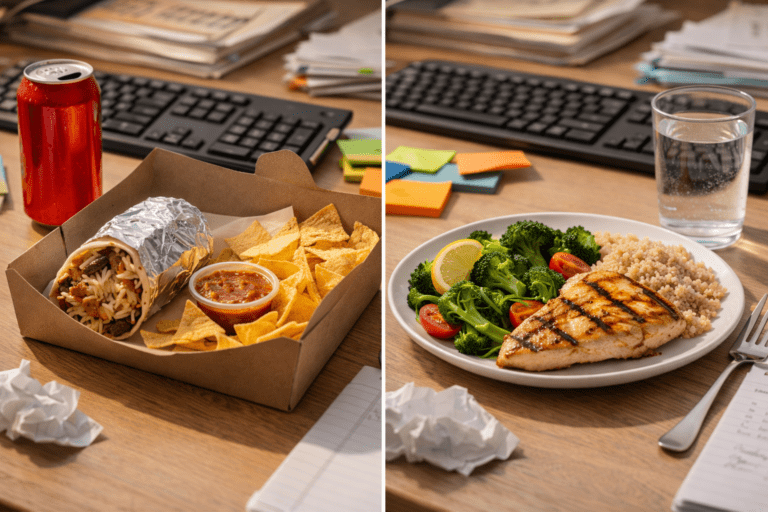
I want to come back to this because I think it’s the piece most people can actually control. Not perfectly. But somewhat.
When you eat a carb-heavy lunch — pasta, bread, rice, the usual suspects — your blood sugar shoots up within about 30 minutes. Feels fine. Feels normal. Then insulin kicks in to bring it back down, and if the spike was steep, the drop is steep too. That’s the crash. It lands right on top of your circadian dip, and the two together create that specific 3PM sensation where you’re staring at your monitor like it’s written in a language you almost but don’t quite speak.
Protein and fat don’t spike blood sugar the same way. They’re slower. Steadier. Less dramatic on both ends. I’m not saying go keto or overhaul your entire diet — that’s exhausting advice and honestly I’ve tried it and lasted about nine days. I’m saying that swapping the bread for an extra scoop of chicken in your lunch bowl is a small thing that makes a noticeable difference by 2:30.
The Cleveland Clinic specifically recommends balanced macronutrient meals to manage post-lunch energy dips. Not groundbreaking. But hearing it from a medical institution makes it feel less like influencer advice and more like… just how the body works.
7 Things That Actually Help With the Afternoon Slump
What Is the Afternoon Slump?
The afternoon slump (also called the “post-lunch dip” or “3PM energy crash”) is a predictable period of decreased alertness, focus, and motivation that typically hits between 1PM and 4PM. It’s driven by circadian rhythm biology, blood sugar fluctuations, and environmental factors like prolonged sitting, artificial lighting, and indoor air.
Here are the things that have made a real difference for me and for people I’ve watched deal with this. Not all at once. Not perfectly. Just… over time.
Move before the wall hits — not after.
Everyone says take a walk when you feel tired. Here’s what actually happens: by 2:45, you’re so deep in the fog that standing up feels like a major life decision. You tell yourself you’ll get up in five minutes. You don’t. Move around 12:45 or 1PM instead. A lap around the building. Taking a call standing up. Anything that interrupts the stillness signal before your body fully commits to powering down.
Stop treating lunch like it doesn’t matter.
More protein. Some healthy fat. Fewer simple carbs. That’s genuinely the whole thing. The giant burrito with extra rice is delicious and will also park your brain in a ditch for two hours. I still eat it sometimes. But I know what it costs me now.
Get outside, even for five minutes.
Natural light is probably the most underrated tool on this list. Sunlight — even on a cloudy November day in Cleveland — sends your brain a stronger “stay alert” signal than another cup of coffee. The Mayo Clinic recommends natural light exposure for circadian rhythm regulation. Five minutes. That’s it.
Time your caffeine like it matters. Because it does.
Not “quit coffee.” Just shift it. If you’re going to have an afternoon cup, make it 12:30 or 1PM — not 3. Caffeine has a half-life of about five to six hours. For most people going to bed around 10 or 11PM, anything after 2PM is borrowing from tonight’s sleep to pay for today’s alertness. Bad trade.
Front-load the hard stuff.
Your best cognitive hours are before noon. That’s when cortisol is highest and your circadian rhythm is fully on your side. Do the deep thinking, the creative work, the decisions that require actual brainpower — do all of that before lunch. Save email, admin, routine tasks for the afternoon. This isn’t productivity hacking. It’s just scheduling around your biology.
Actually change positions. I know. I know.
Most people — myself very much included — know they should move more at their desk and still sit in the same position for three hours straight. On the days I actually remember to stand up, shift around, even just stretch for thirty seconds, the 3PM wall is noticeably shorter. Not gone. Just… shorter.
The 20-minute nap, if you can swing it.
If you work from home even a couple days a week, a short nap between 1PM and 2PM is honestly the single most effective thing on this list. The CDC acknowledges that brief naps improve alertness and performance. Set a timer. Twenty minutes. Not forty-five — that pulls you into deep sleep and makes it worse. I know napping feels indulgent. It’s not. It’s biology.
When the 3PM Crash Might Be Something More Serious
I’ll be honest about something. I ignored my own afternoon fatigue for close to three years. Just muscled through it. Figured that’s how everyone felt and I needed to deal with it.
When I finally went in for bloodwork — partly because my wife basically made me — my vitamin D was in the basement. Like, clinically low. A $4 bottle from CVS. That’s all it took. Within a few weeks, the afternoons were genuinely different. Not perfect, but different.
Looking back, it’s embarrassingly obvious. At the time I just kept thinking I needed more sleep.
The afternoon slump is normal. But sometimes the thing that feels like an ordinary dip is your body trying to tell you something specific.

See your doctor if:
The fatigue is new, sudden, or markedly worse than your usual baseline
You’re sleeping 7-8 hours and still feel exhausted all day — not just afternoons
You’re noticing unexplained weight changes, hair loss, or persistent mood shifts
Nothing you try — sleep, food, movement, caffeine changes — makes any difference
You feel dizzy, short of breath, or foggy in ways that go beyond normal tiredness
Hypothyroidism. Iron-deficiency anemia. Sleep apnea. Depression. Vitamin deficiencies. All of these disguise themselves as “just being tired.” A basic blood panel through your PCP can rule out most of them. It’ll cost a copay and maybe a morning off work. But knowing beats guessing. Every time.
Quick disclaimer — I’m not a doctor. Not even close. Just someone who’s spent way too many afternoons staring through a screen wondering what was wrong with me. For anything medical, please talk to your actual provider.
Frequently Asked Questions About the Afternoon Slump
Why do I always feel tired at 3PM even when I sleep well?
Your circadian rhythm has a natural dip in alertness during early-to-mid afternoon — usually between 1PM and 3:30PM. This happens regardless of sleep quality. Good sleep makes the dip less severe but doesn’t eliminate it entirely. It’s hardwired into human biology.
Is the afternoon slump the same as a blood sugar crash?
Not exactly, but they often overlap. The circadian dip happens on its own internal schedule. A blood sugar crash depends on what and when you ate. When both hit simultaneously — which they usually do after a carb-heavy lunch — the combined effect is what makes 3PM feel so brutal.
Does caffeine actually help with the 3PM crash?
Short term, yes. But caffeine consumed after about 2PM can interfere with sleep quality that night, which makes the next day’s crash worse. It’s a cycle. If you’re going to use caffeine, earlier is better — ideally before 1PM.
When should I see a doctor about afternoon fatigue?
If the tiredness is new, persistent, dramatically worse than normal, or isn’t improving with better sleep, nutrition, and movement — it’s worth getting bloodwork done. Conditions like thyroid disorders, anemia, and vitamin deficiencies are common, treatable, and frequently mistaken for ordinary tiredness.
What I Actually Think About All This
I’m aware of what I just did. I wrote two thousand words about being tired in the afternoon. I listed tips. I cited medical sources. This is, on some level, exactly the kind of article I’d scroll past on a Tuesday morning while drinking coffee and pretending to read industry news.
But I guess what I’m actually trying to say — and I’ve been circling around it this whole time — is that the afternoon slump isn’t your fault. It’s not a character flaw. It’s not because you’re lazy or undisciplined or eating wrong or sleeping wrong. It’s a basic feature of human biology that the modern workday completely ignores. And then you’re left to manage it alone, between Zoom calls, without anyone really acknowledging it.
Some of what I’ve described here will help. The lunch changes, the light exposure, the caffeine timing — those are the ones that moved the needle for me. Some might not fit your schedule or your body or your life at all. I genuinely don’t know what’ll work for you. And I’m suspicious of anyone who claims they do.
The goal isn’t to eliminate the dip. I don’t think that’s realistic for most people, most days. The goal is to stop it from hijacking your entire afternoon. And to stop feeling guilty about something your body was always going to do.
Not a cure. Just a better understanding.
That’s been enough for me. Most days.