


That Tiredness You Keep Explaining Away
You know that feeling around 2:30 in the afternoon — the one where your eyelids get heavy, your skull feels stuffed with cotton wool, and you catch yourself reading the same Slack message three times? Most of us blame lunch. Or the weather. Or just “getting older, yaar.”
But here’s the thing. Sometimes that tiredness isn’t normal. Sometimes it’s been creeping up so slowly — over months, maybe years — that you’ve forgotten what feeling actually rested even feels like.
Iron deficiency symptoms have this quiet, almost sneaky quality. They don’t arrive with drama. No sudden pain, no alarming rash. Just a slow erosion of energy that you accommodate, adjust around, and eventually stop questioning. You take the lift instead of the stairs. You cancel evening plans more often. You drink that third cup of chai not because you enjoy it but because you genuinely cannot function without it.
And the most frustrating part? When someone finally suggests you might be low on iron, your first reaction is probably, “Nah, I eat fine.” Mine was. For longer than I’d like to admit.
What Iron Actually Does (And What Happens When It Drops)
See, the problem is that most of us think of iron as just… a nutrient. One of those things listed on the back of a cereal box. But iron does something very specific and very critical — it helps make haemoglobin, the protein in your red blood cells that carries oxygen to literally every tissue in your body.
When iron levels dip, your body produces fewer healthy red blood cells. Less haemoglobin. Less oxygen reaching your muscles, your brain, your organs. Your body doesn’t shut down — it compensates. Your heart works harder. Your lungs work harder. You still function. Just… worse. A bit greyer. A bit slower.
This is iron deficiency anaemia in its early stages. And what I’ve noticed, again and again — in friends, in family, in colleagues who finally got their CBC done — is that people live with this diminished version of themselves for years before anyone thinks to check.
The signs of iron deficiency don’t look like illness. They look like life. Like stress. Like “maybe I’m just not sleeping well.” Which is partly why they’re so easy to miss, and partly why they deserve a closer look.
What Most People Get Wrong About Low Iron

There are a few misconceptions about iron deficiency symptoms that genuinely irritate me. Not mildly. Actually irritate me.
The first: “Just eat more palak.” As if spinach is some magical cure-all. Spinach does contain iron — the non-haeme kind — but it also contains oxalates that reduce iron absorption. So that palak paneer your aunt insists will “fix your blood”? It’s good food. It’s not medicine. And it’s certainly not a replacement for understanding what your body actually needs.
The second misconception — and this one is worse — is that iron deficiency only affects women. Yes, menstruating women are at significantly higher risk. That’s biology. But men get it too. Children get it. Elderly people living on tea and biscuits get it. I’ve seen a perfectly healthy-looking 35-year-old man discover his haemoglobin was 9 g/dL during a routine insurance medical. He’d been blaming his exhaustion on his commute.
The third: “If I were iron deficient, I’d know.” No. You probably wouldn’t. Or rather, you would — your body would be telling you constantly — but you’d have a perfectly reasonable explanation for each symptom. That’s how it works. The symptoms of low iron levels are common enough to be dismissed and specific enough to matter.
What nobody tells you — and this still frustrates me — is that doctors sometimes miss it too. You go in complaining of fatigue, and you leave with advice to “sleep better” or “reduce stress.” Nobody orders the iron studies. Just the basic CBC, which might look borderline normal while your ferritin (stored iron) is quietly bottoming out.
Why India Has a Particular Problem
India has one of the highest rates of iron deficiency anaemia in the world. That’s not opinion — that’s ICMR data, National Family Health Survey data, repeated across decades. According to NFHS-5, over 57% of Indian women aged 15–49 are anaemic. More than half. Think about that for a moment.
The reasons are layered. Some are dietary — a large vegetarian population means more reliance on plant-based (non-haeme) iron, which the body absorbs less efficiently. Some are cultural — that uncle at every family gathering who insists that beetroot juice will “increase your blood” while dismissing the idea of actual supplementation. Some are systemic — government hospitals stretched thin, private consultations costing ₹500–₹1,500 per visit, and the assumption that fatigue is just what life feels like when you’re managing a household, a job, and possibly ageing parents under one roof.
Then there’s the climate factor. In peak summer — April, May, the weeks before monsoon arrives — everyone is tired. Everyone is drained. It becomes nearly impossible to distinguish between heat exhaustion and genuine iron deficiency in India. The symptoms blend right into the season.
And the food habits? We drink chai with meals — sometimes two cups during lunch itself — and the tannins in tea actively inhibit iron absorption. Nobody mentions this. It’s almost absurd, when you think about it. Our most beloved daily ritual might be quietly undermining our iron levels.
So What Are the Actual Signs? A Realistic List
Let me lay out the common iron deficiency symptoms plainly. Not dramatically. Not with Instagram-worthy graphics. Just as they actually show up in daily life.
- Persistent, unexplained fatigue
Not “I stayed up late” tiredness. The kind where you wake up after seven hours and still feel like you haven’t slept. The kind where climbing two flights of stairs leaves you slightly breathless. This is often the earliest and most ignored sign of iron deficiency. - Pale skin, pale inner eyelids, pale nail beds
Pull down your lower eyelid gently. If the inside looks pale pinkish-white instead of a healthy red, that’s worth noting. Your nails might look unusually pale too, or become brittle and spoon-shaped (koilonychia, if you want the medical term). - Unusual breathlessness
Walking to the auto stand shouldn’t leave you winded. If routine physical activity suddenly feels harder, low haemoglobin levels could be limiting oxygen delivery to your muscles. - Heart palpitations or a racing pulse
Your heart compensates for fewer oxygen-carrying red blood cells by beating faster. That random flutter you feel when you’re just sitting at your desk? Don’t ignore it. - Cold hands and feet
Even when it’s 34 degrees outside. Even when everyone else is sweating. Poor iron levels affect circulation, and your extremities feel it first. - Headaches, dizziness, difficulty concentrating
The brain is oxygen-hungry. When supply drops, you get foggy thinking, frequent headaches — particularly when standing up quickly — and that maddening inability to focus during meetings. - Unusual cravings (pica)
Craving ice, chalk, clay, or starch. This one sounds bizarre until you’ve experienced it or seen someone experience it. It’s a real, documented symptom. Not a personality quirk. - Restless legs
An uncomfortable, crawling sensation in your legs, especially at night. Often dismissed as “just restlessness.” Often linked to low ferritin.
Now — here’s the “what actually happens” gap. A doctor might tell you to “eat iron-rich foods and take a supplement.” You nod, walk out, stop at a medical store, stare at fifteen different iron tablet brands ranging from ₹50 to ₹400, pick one randomly, take it for a week, get constipated, feel worse, and quietly stop. Nobody warns you that iron supplements can cause nausea and black stools. Nobody tells you to take them with vitamin C for better absorption or to avoid taking them with your morning chai.
I suppose what I’m trying to say is — knowing the symptoms is only useful if the next steps are also realistic.
Some things that actually help:
- Get a proper blood test. Not just CBC. Ask specifically for serum ferritin, serum iron, and TIBC (Total Iron Binding Capacity). Thyrocare and SRL Diagnostics offer iron profile panels for ₹400–₹800. You don’t always need a prescription.
- Space chai away from meals. At least an hour gap. This alone can meaningfully improve iron absorption from food. Annoying? Yes. Worth trying? Also yes.
- Pair iron-rich foods with vitamin C. Squeeze lime over your dal. Eat amla. Have an orange after lunch. This combination genuinely boosts non-haeme iron absorption — there’s solid evidence for it.
- If supplements are prescribed, be patient. They take 6–8 weeks to show real improvement. Side effects (constipation, dark stools, metallic taste) are common. Taking them every alternate day — as some recent research suggests — may reduce side effects while maintaining effectiveness.
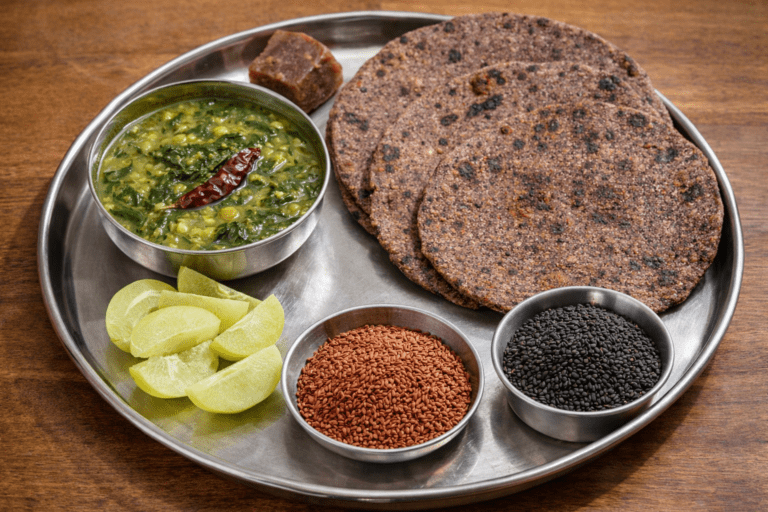
- Don’t dismiss traditional foods, but don’t overestimate them either. Jaggery, ragi, bajra, garden cress seeds (halim), black sesame — these are genuinely good sources. But if your ferritin is 5 ng/mL, food alone isn’t going to rescue you. Be honest about severity.
When to Actually See a Doctor

I’ll be honest — I ignored my own symptoms for nearly two years. I blamed Bangalore’s late-night work culture, my erratic eating, the general chaos of my early thirties. When I finally got a blood test done — not even for iron, it was a routine check — my ferritin was worryingly low. The doctor looked at me like, “How have you been functioning?” Good question. Badly, as it turns out. Just not badly enough to stop.
See a doctor — not “eventually,” but soon — if you experience:
- Fatigue that doesn’t improve with rest, lasting more than 2–3 weeks
- Noticeable pallor, especially in your gums, inner eyelids, or nail beds
- Breathlessness during normal activities
- Heart palpitations at rest
- Pica cravings (ice, clay, starch)
- Heavy menstrual bleeding that soaks through protection within an hour
Iron deficiency anaemia symptoms can overlap with thyroid issues, vitamin B12 deficiency, and other conditions. Self-diagnosis from a symptoms list — even a well-written one — has limits. A ₹600 blood panel gives you clarity that no amount of Googling can.
The Quiet Thing Nobody Wraps Up Neatly
I realise much of this sounds like standard health advice dressed in relatable language. Maybe it is, partly. But what I actually want to leave you with is this: low iron doesn’t feel like a “health problem.” It feels like a personality trait. You start thinking of yourself as “the tired one,” “the lazy one,” “the one who can’t keep up.” You build your identity around a deficiency you haven’t been tested for.
That’s not dramatic. That’s just what quietly happens.
Iron deficiency symptoms are not a life sentence. They’re not even complicated to address, most of the time. But they do require you to stop explaining them away and start taking them at face value. Not with panic. Not with a complete lifestyle overhaul. Just — a blood test. A conversation with a doctor. Maybe a small dietary tweak.
Not everyone reading this will be iron deficient. But most people reading this are tired. And some of you — maybe more than some — are tired for a reason that has a name, a test, and a solution.
That’s worth knowing. Quietly, without fuss.