


You know that niggling thing you’ve been meaning to sort out? That twinge in your lower back, the headache that returns most Wednesday afternoons, the tiredness that three cups of tea and a biscuit can’t shift. Small health problems have a quiet way of moving into your life — not dramatic enough to act on, but persistent enough that you notice them at strange moments.
Like that feeling around 3pm when your eyes won’t quite focus on the screen, and you realise you’ve been pressing your thumb into the same sore spot on your neck for the past hour without noticing. Not pain, exactly. Just something.
Most of us — and I’m very much including myself here — respond to these moments with a silent negotiation. We tell ourselves it’s probably nothing. We Google it at midnight, scare ourselves half to death, then decide Google’s wrong. We carry on. For a while, carrying on works perfectly well.
Until it doesn’t.
This piece is about that gap. The space between “it’s probably nothing” and “I really wish I’d done something sooner.”
How Small Health Problems Quietly Escalate
The body is annoyingly good at compensating. You develop a dodgy knee, so you shift weight to the other leg. That creates a hip problem you barely register. Your sleep deteriorates, so you drink more caffeine, which worsens your sleep, which — well. You can see where this goes. It’s rarely one dramatic failure. It’s a slow cascade of tiny adjustments, each perfectly reasonable on its own.
What I’ve noticed, over years of watching friends, family, and myself do this exact thing, is that we don’t ignore symptoms because we’re foolish or lazy. We ignore them because they’re bearable. And bearable feels dangerously close to fine.
There’s a term for this — symptom normalisation. It means you gradually adapt to the discomfort until it becomes your new baseline. The headache isn’t alarming anymore; it’s just Wednesday. The breathlessness isn’t concerning; you’re just unfit. Or getting older. Or both.
What does symptom normalization actually mean?

Symptom normalization is the process by which ongoing or recurring health symptoms become so familiar that you stop recognising them as problems. Instead of triggering concern, they blend into your daily experience. This can delay diagnosis and allow minor, treatable conditions to progress into something more complex.
Here’s the thing that rarely gets said plainly enough: many minor health issues genuinely are minor. They resolve without intervention. A pulled muscle heals. A cold passes. The trouble is that the problems which won’t resolve on their own often look identical to the ones that will — at least early on. A persistent cough is usually just a persistent cough. Except sometimes it isn’t.
That ambiguity is the real problem. Not stupidity. Not carelessness. Just genuine uncertainty about whether something deserves attention.
The Misconceptions That Keep Us Stuck
There’s a widespread assumption that people who let health issues escalate are somehow neglectful — that if they’d just “taken it seriously” from the start, everything would be sorted. Sometimes that’s fair. But it misses something quite fundamental about how people actually live.
What nobody tells you — and this genuinely frustrates me — is that the advice to “listen to your body” is almost useless without context. Listen for what, exactly? Bodies are noisy. They ache, twinge, gurgle, click, and crack constantly. If you responded to every signal with a GP appointment, you’d need to be seen weekly. For the rest of your life.
The other misconception is that there’s always a clear turning point. Some dramatic moment when a minor symptom announces it’s becoming something bigger. In reality, the shift is almost always gradual. Only obvious when you look backwards. Looking back, it’s plain as day. At the time? Not remotely.
People also assume that early detection is just a matter of willpower. “Just go to the doctor.” As though the barriers are purely psychological. They’re not. They’re practical, systemic, cultural. Which brings us to something worth acknowledging.
And then there’s the internet. Simultaneously the best and worst thing to happen to health literacy. You can access clear, evidence-based NHS guidance in seconds. You can also convince yourself you’re dying based on a Mumsnet thread from 2011. The signal-to-noise ratio is genuinely appalling.
Why This Hits Differently in Britain
Let’s be honest about some things that are specifically, stubbornly British about this whole problem.
There’s that particular reluctance to “make a fuss” at the GP surgery. That creeping guilt about booking an appointment for something that might turn out to be nothing. The quiet rehearsal you do in the waiting room — working out how to describe your symptoms without sounding like you’re wasting anyone’s time. Downplaying it before you’ve even been asked. I’ve done this. Everyone I know has done this.
Then there’s the practical reality of actually getting seen. In many parts of the country, booking a GP appointment now involves ringing at 8am sharp, sitting on hold while a recorded message tells you how important your call is, and hoping there’s something left. If your issue doesn’t feel urgent enough for that particular battle on a grey Monday morning, you put it off. You tell yourself you’ll try next week.
You don’t try next week.
The weather plays a role too, oddly. Six months of overcast skies, damp cold, and fading daylight, and a certain level of feeling rubbish starts to seem… seasonal? Normal? Just what January through to March is like? It gets harder to tell the difference between genuine symptoms and the general low-grade malaise of a British winter.
And the cost of living reality means people are working longer hours, sleeping less, eating convenience food not because they don’t know better but because better costs more — in money, in time, or both. Ignoring health symptoms becomes easier when you’re stretched thin. Stress feeds inflammation. Poor sleep slows recovery. It’s a cycle, and you can’t wellness-blog your way out of it.
What You Can Actually Do
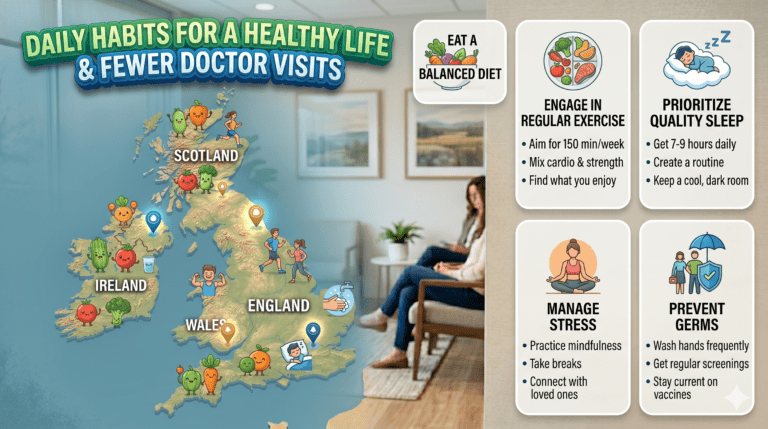
I’m aware I’ve entered standard-advice territory here. Stay with me — I’ll try to be honest about what genuinely helps versus what just sounds good in an article.
In theory, you’d keep a detailed symptom diary, eat a balanced diet, sleep a solid eight hours, and exercise three times a week. In practice, you scribble something on the back of a receipt, eat toast for dinner because you’re absolutely knackered, lie awake until half one worrying about work, and feel vaguely guilty about the gym membership you haven’t touched since February. That’s not failure. That’s just… life.
So here’s what I’d genuinely suggest, knowing what real life actually looks like:
- Write symptoms down when they happen. Not in a leather-bound journal. In your phone notes. Date, what you felt, rough severity out of ten. Takes fifteen seconds. When you eventually see a GP, this is gold dust. Patterns emerge that your memory simply won’t catch three weeks later.
- Set a time limit, not a severity threshold. Rather than waiting until something feels “bad enough,” decide now: if this is still happening in three weeks, I’m making an appointment. It removes the daily internal debate about whether it’s “worth it yet.” Three weeks. Mark it in your calendar. Done.
- Use NHS 111 for the ambiguous stuff. It exists precisely for the “probably nothing but maybe something” space. You can call or use the online tool. It’s not just for emergencies and it’s not just for midnight crises — it’s built for uncertainty.
- Mention it to someone. Not dramatically. Just say it out loud. “My shoulder’s been rough for a while” or “I keep getting these headaches.” The moment you say it to another person, it becomes harder to dismiss. And other people are annoyingly good at saying what you already know: “You should probably get that checked.”
- Stop measuring against your worst. We tend to judge current symptoms against the most ill we’ve ever been. If it’s not as bad as that time you had norovirus on a family holiday in Cornwall, it doesn’t count. But “not the worst pain of my life” and “actually fine” aren’t the same thing. Not even close.
- Be specific with your GP. “I’ve had a dull headache most afternoons for about six weeks” gives them something to work with. “I just feel rubbish all the time” is harder to act on. Bring the phone notes. Give them dates, patterns, anything concrete.
- Accept that some things need managing, not curing. This one took me years. Genuinely, years. Not every health problem has a tidy resolution. Some conditions are chronic. Some are cyclical. Learning to manage them properly — instead of swinging between total denial and late-night catastrophising — is one of the most useful things you can do. Not exciting. Not revolutionary. But useful.
I don’t know if all of these will make a difference for you. Some might feel blindingly obvious. But I’ve found that the gap between knowing something and actually doing it is precisely where most early signs of health problems get quietly, steadily worse.
When It’s Time to Stop Waiting
I’ll be honest — I ignored persistent stomach pain for the better part of a year. Told myself it was stress. Partly, it was stress. It was also something that needed proper treatment, and the delay made everything longer and more unpleasant than it needed to be. I don’t say that to scare you. I say it because I understand the impulse to wait, and I know where waiting can end up.
Some health warning signs shouldn’t wait:
- Any symptom that’s persisted more than three weeks without improving
- Unexplained weight loss
- Blood where there shouldn’t be blood
- A new or growing lump
- Persistent changes in bowel or bladder habits
- Breathlessness that’s new or getting worse
- A mole that’s changed shape, size, or colour
The NHS website has thorough, regularly updated guidance on these. Trust it over health forums. Trust it over me, honestly.
And if you feel you’re being dismissed, you are allowed to go back. You’re allowed to ask again, to push for a referral, to say “I’m still not right.” That’s not making a fuss. That’s being a reasonable adult looking after yourself.
The Quiet Bit at the End
I’m aware I’ve just written two thousand-odd words that essentially amount to: pay attention to small health problems before they snowball. Which isn’t exactly groundbreaking.
But I suppose what I’m trying to say is that the barrier usually isn’t knowledge. Most of us know we should get things checked sooner. The barrier is everything else — the busyness, the stoicism, the truly difficult GP access, the nagging uncertainty about whether it’s “worth bothering” anyone.
It’s worth it. Almost always.
Not because every minor niggle is secretly catastrophic. Most aren’t. But because the peace of mind that comes from actually knowing — rather than lying awake guessing — is worth the awkward phone call and the waiting room and the slightly embarrassing conversation.
You don’t need to overhaul anything. You just need to stop putting yourself last on a very long list.
Which is, I appreciate, easier said than done. But it’s a decent place to start.